

Lung adenocarcinoma (LUAD), the most common subtype of non-small cell lung cancer in clinical practice, is characterized by a high mutation rate of the p53 gene, poor prognosis, and a lack of precise targeted therapies—posing a major challenge for precision oncology. In particular, LUAD driven by gain-of-function mutant p53 (GOF-p53) exhibits high malignancy and drug resistance, long regarded as an “undruggable” target. Novel intervention strategies are urgently needed.
Recently, the research team led by Prof. Zhang Ze-Yan from our Institute/School of Basic Medical Sciences, in collaboration with Chongqing University and other institutions, published a study titled MST4 plays dual roles in lung adenocarcinoma by regulating homeostasis of wild-type and mutant p53 protein in the classic oncology journal Oncogene. This work identifies MST4 kinase as a p53 status-dependent bidirectional regulator, elucidates a novel kinase activity-independent mechanism whereby MST4 competitively stabilizes p53, and provides a new precise therapeutic target for GOF-p53-driven LUAD.
The study reveals that MST4 is significantly overexpressed in LUAD tissues, with its expression level strongly correlated with tumor grade, lymph node metastasis, and poor patient prognosis. Functional experiments demonstrate that MST4 exerts p53 status-dependent dual roles in LUAD: it acts as a tumor suppressor in wild-type p53 (wtp53) cells, inhibiting proliferation, colony formation, and migration of tumor cells; conversely, it exhibits oncogenic activity in GOF-p53 mutant cells, accelerating malignant tumor progression. Mechanistically, MST4 functions independently of its kinase activity, directly interacting with the DNA-binding domain of p53 protein. It competitively blocks the binding of the E3 ubiquitin ligase MDM2 to p53, thereby inhibiting MDM2-mediated K48-linked ubiquitination and proteasomal degradation, and stabilizing both wtp53 and GOF-p53 proteins—ultimately determining its bidirectional function. In vivo experiments confirm that targeted knockout of MST4 significantly suppresses the growth of GOF-p53-driven LUAD xenografts and enhances chemosensitivity.
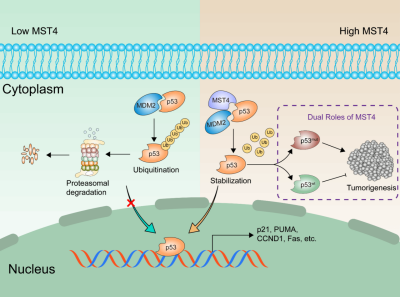
This study uncovers a novel paradigm for p53 homeostasis regulation and clarifies the molecular mechanism of MST4 as a bidirectional regulator in LUAD, laying a new theoretical foundation for the precise treatment of GOF-p53-driven LUAD. Targeting MST4 specifically inhibits the growth of GOF-p53-driven LUAD, offering a new therapeutic target for these refractory tumors. It addresses the limitation of current p53-targeted agents (e.g., MDM2 inhibitors), which are only effective in wtp53 tumors, and holds important clinical translational value.
Profs. Zhang Ze-Yan (Institute/School of Basic Medical Sciences) and Li Shangze (School of Medicine, Chongqing University) are co-corresponding authors of the paper. Zhenghui Hu (PhD candidate, School of Basic Medical Sciences, Nanchang University) and Haokai Wang (undergraduate student) are co-authors.
Original Article Link:https://doi.org/10.1038/s41388-026-03824-7
(Source:Institute of Biomedical Innovation, Nanchang University)