

Myocardial infarction causes extensive cardiomyocyte loss due to ischemic and hypoxic injury. Because adult mammalian cardiomyocytes have very limited proliferative capacity, damaged myocardium is largely replaced by fibrotic scar tissue, leading to progressive cardiac dysfunction and heart failure. Reactivating cardiomyocyte proliferation therefore remains a major goal in cardiac regenerative medicine, and small molecules offer a promising strategy because of their tunable activity and flexible administration.
In previous work, Professor Jing-Wei Xiong’s team from the Institute of Biomedical Innovation and the School of Basic Medical Sciences at Nanchang University identified a five-compound cocktail, 5SM, consisting of phenylephrine hydrochloride (PE), baricitinib, harmine (HM), VO-OHpic trihydrate, and AZD3965. 5SM promoted cardiomyocyte proliferation, improved cardiac function, and reduced myocardial fibrosis in adult rat models of myocardial infarction and ischemia-reperfusion injury. Subsequent work published in the Journal of Molecular and Cellular Cardiology identified TGF-β/BMP-SMAD4 signaling as an important mechanism underlying these regenerative effects.
The complexity of the five-small-molecule combination 5SM poses challenges for mechanistic dissection and future therapeutic development. The team therefore sought to simplify the cocktail while clarifying the functional interactions among its components. In a recent study published in Cell Regeneration, entitled “Small-molecule cocktail 2SM promotes heart regeneration via inducing embryonic-like cardiomyocyte state,” they identified a two-small-molecule combination, termed 2SM, consisting of PE and HM, and further elucidated how the two compounds act cooperatively to promote cardiomyocyte proliferation.
The study found that 2SM promoted cell-cycle entry and completion of cell division in neonatal mouse and rat cardiomyocytes and enhanced cell-cycle activity in human induced pluripotent stem cell-derived cardiomyocytes. In adult myocardial infarction models, 2SM promoted cardiomyocyte cytokinesis in mice and increased cardiomyocyte cell-cycle activity in the infarct border zone of rats, accompanied by improved cardiac function and reduced infarct size.
Mechanistically, PE and HM act at distinct stages of the cell cycle in a temporally coordinated manner. PE induces a fetal-like transcriptional program and activates mTORC1 signaling, promoting entry into G1/S while also causing G2/M arrest; HM relieves this arrest through inhibition of DYRK1A and activation of the MMB/FOXM1-MuvB transcriptional program, thereby enabling progression through mitosis and cytokinesis. Accordingly, sequential treatment with PE followed by HM was more effective in driving cardiomyocytes through a complete cell cycle.
Transcriptomic and metabolomic analyses further showed that 2SM activates cell-cycle programs, enhances glycolysis, and suppresses fatty-acid metabolism, indicating a shift toward an embryonic-like cardiomyocyte state that supports proliferation.
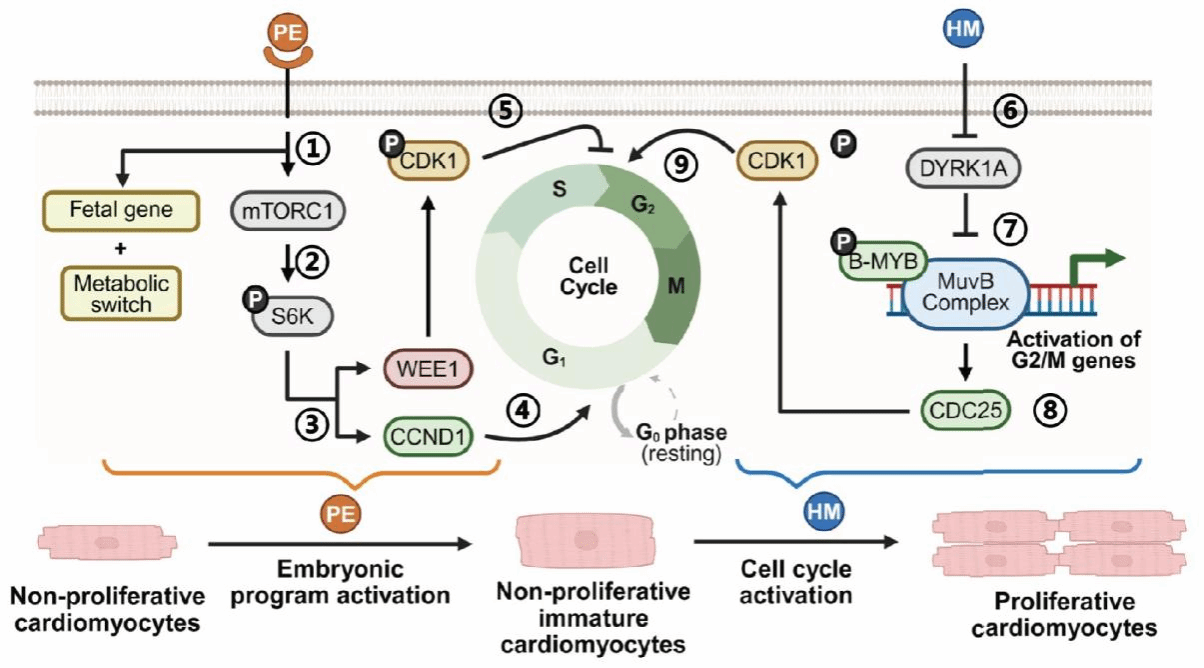
By reducing the original five-compound cocktail to PE and HM, this study retains the pro-proliferative and regenerative effects of 5SM while revealing how the two compounds coordinate distinct stages of the cell cycle. These findings provide a basis for further optimization of small-molecule strategies for cardiac regeneration.
Zihao Wang, a doctoral graduate of Peking University, is the first author of this paper. Associate Researcher Lixia Zheng and Professor Jing-Wei Xiong of the School of Basic Medical Sciences, the Second Affiliated Hospital of Nanchang University, and the Institute of Biomedical Innovation are the co-corresponding authors.
Article
Small-molecule cocktail 2SM promotes heart regeneration via inducing embryonic-like cardiomyocyte state
Cell Regeneration
DOI: 10.1186/s13619-026-00301-0